The receiver
Northing One
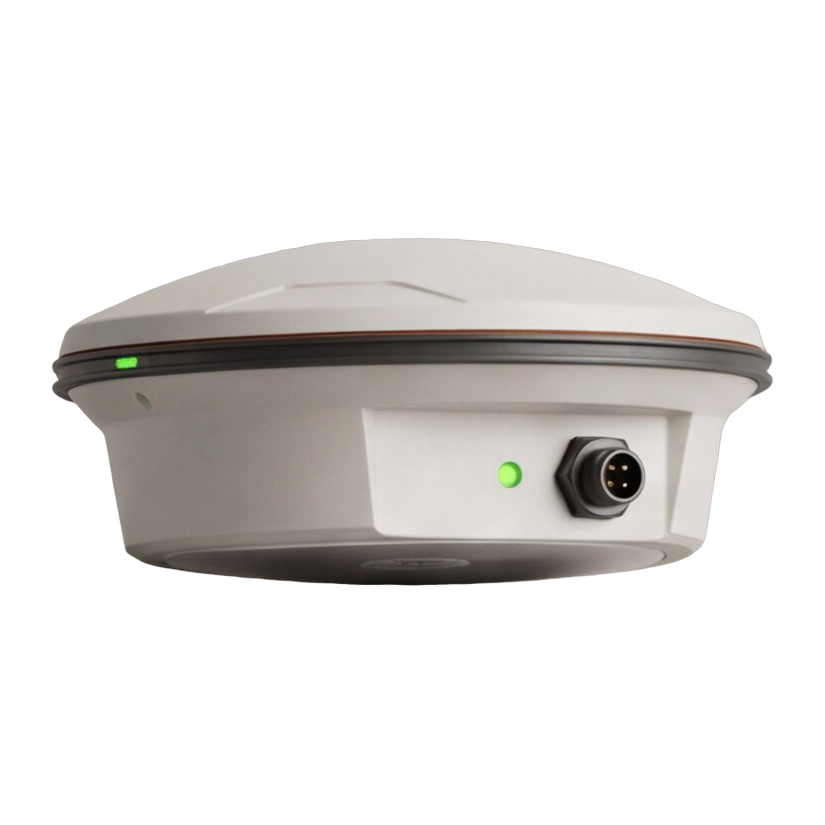
A sealed, multi-band, multi-constellation GNSS receiver that mounts where you need position truth and talks to the phone in your pocket. $999 one-time, with 12 months of Northing RTK corrections included — then a flat $299 a year, or nothing at all and it keeps working.
Pilot batch late 2026. No payment taken until units ship.
Numbers come from logged dual-receiver field sessions, not a brochure — the method and the fine print are in RTK vs PPP.
What it does
Four decisions, and what each one buys you.
Multi-band, multi-constellation
It tracks all four global satellite constellations — the American, European, Chinese and Russian systems — on multiple frequency bands, including the high-accuracy band most consumer hardware ignores. Two frequencies let the receiver measure the ionospheric delay instead of modelling it, which is what makes centimeter work possible at all; four constellations is about how much sky you have left under a hedge.
Your phone is the monitor
No screen, no proprietary terminal, no cellular modem. Position and status stream to the phone over Bluetooth Low Energy and corrections stream back at about 1 kbps. Nothing to crack, nothing to wash out in sunlight, no second SIM and no second data plan.
An open protocol
The Bluetooth protocol is published and a free Swift SDK is on the way, so any app can read position, fix state, satellite counts and health without a partnership agreement. It works today with Tractor GPS, and with any app that adopts the protocol. A published protocol is the part that is hardest to quietly withdraw.
Mounted where position matters
One sealed unit — roof, bar, pole or bracket — powered from 5 V USB. No separate antenna to site, no coax to get wrong, no control box in the cab. The point you mount is the point you measure, so there are no offsets to remember six months later.
Field updates
Five layers, because the one above can fail.
A receiver bolted to a roof bracket in February is not something anyone should have to post back, so the update path is built defensively:
-
Signed firmware
Updates are cryptographically signed; the receiver refuses anything that does not verify.
-
A/B partitions
The new version lands beside the running one and rolls back by itself if it misbehaves.
-
Resumable transfers
An update interrupted by a dropped Bluetooth link resumes where it left off.
-
Crash-loop safe mode
Repeated failures drop the unit into a minimal mode that can still be talked to.
-
Browser recovery flasher
Worst case: a web page and a USB cable. No special hardware, no dealer, no return shipping.
Status you can trust
It tells you when it stops being sure.
GNSS engines have a well-known failure mode: when a correction stream dies silently, many keep reporting centimeter confidence while the true error drifts. We measured exactly that — quality flags, accuracy estimates and correction-age fields all frozen while real error grew from 7 cm toward 40 cm.
So the receiver runs an independent watchdog that does not ask the engine's opinion. If corrections stop flowing for 30 seconds it raises "Stale Corrections" to every connected app regardless. Precision you cannot verify is decoration; that is the whole reason this feature exists.
The same instinct runs through the diagnostics: fix history, correction age, satellite counts, signal levels, firmware version and what the watchdog saw, exported as a support bundle you can send in one message. Support starts from data rather than from a description — and it keeps us honest, because those are the same records the measured claims on this site come from.
Reading the fix state
- 3D fix
- An ordinary uncorrected position — metres. What a phone gives you all day.
- Float
- Corrections are arriving but the whole-cycle ambiguities are not resolved yet. Decimetres, improving. A transitional state, not a destination.
- Fixed
- Ambiguities resolved. The ±2.5 cm state, and the only one to plan repeated passes around.
The full read on fix states is in how Northing RTK works.
Specifications
The rows we can fill, and the ones we won't guess.
The pilot enclosure is in industrial design, so the physical numbers do not exist yet in any form worth publishing. They are marked below rather than estimated. Every claim on this site traces to a logged session, and a spec sheet is not the place to make the first exception.
| Battery life away from power | No battery inside — the receiver runs from the machine it is on. |
|---|---|
| Power input | 5 V USB. An ordinary cable from a supply you already have. |
| Antenna | Integrated. One sealed unit, no separate antenna to site and no coax run. |
| Link to the phone | Bluetooth Low Energy. Corrections in at about 1 kbps, position and health out. |
Not yet
What it does not do today.
Roadmap items, described as roadmap items — a shipped date we have not earned is exactly the kind of claim this site exists not to make.
-
Raw observation logging
On the roadmap. If your workflow is log-now-correct-later, this is not the receiver for you today.
-
A published SDK
The Bluetooth protocol is public now; the free Swift package that wraps it is on the way, with other languages following demand rather than a plan.
-
An AgOpenGPS-native mode
On the roadmap, and wanted — that community buys receivers constantly and is unusually good at finding the edges of one.
Read further
The long versions.
- Inside the receiver — every capability on this page in full, including what it refuses to do and why.
- How Northing RTK works — what the correction stream contains and how it reaches the receiver.
- RTK vs PPP — instant centimeters versus patient decimeters, and which one your work actually needs.
- All nine guides — coverage, cost across the market, and what accuracy really means.
$999, with a year of RTK in it.
Then $299 a year, flat, with a reminder email before every renewal — or cancel and keep a working decimetre-class instrument.